Roof Ridge Vent Installation in Marietta, GA
Ridge ventilation is the single most underrated factor in how long a roof actually lasts. A roof with proper ridge venting can hit 28 years on a 30-year shingle. The same roof on the same house with bad ventilation hits 16 years and starts to fall apart. Most premature roof failures we see in Cobb County trace back to ventilation that was never set up right.
We install continuous ridge ventilation across Marietta, GA and the rest of Cobb County, usually as part of a roof replacement but sometimes as a stand-alone retrofit on otherwise-healthy roofs.
How Attic Ventilation Actually Works
Hot air rises. In an attic, hot air collects at the peak. Without an exit, it sits there and bakes the underside of the roof deck. Decking heats up to 160 degrees on a Georgia summer afternoon. The shingles above bake from the top and from below at the same time. They lose granules faster, become brittle, and fail early.
A balanced ventilation system has intake at the eaves (soffit vents) and exhaust at the peak (ridge vent). Cool air enters the soffits, rises through the attic, and exits the ridge. The attic stays close to outdoor temperature. Decking and shingles run cooler. The roof lasts longer.
Why Continuous Ridge Vent Beats Box Vents
More vent area
A continuous ridge vent runs the full length of the ridge. Total exhaust area is much higher than a row of box vents.
Even airflow
Box vents create dead spots between them. Ridge vent pulls evenly along the entire ridge.
Cleaner look
Ridge vent disappears under the ridge cap shingles. Box vents are visible bumps across the roof.
No moving parts
Powered attic fans wear out and break. Ridge vent is passive and lasts the life of the roof.
How a Ridge Vent Retrofit Works
Calculate net free vent area required
Code requires roughly 1 square foot of vent for every 300 square feet of attic floor, balanced 50/50 between intake and exhaust. We measure your attic and calculate.
Verify soffit intake is adequate
Ridge vent without matching intake just pulls air from interior wall cavities, which makes things worse. We confirm soffit vents are clear of insulation, baffled if needed, and sized correctly.
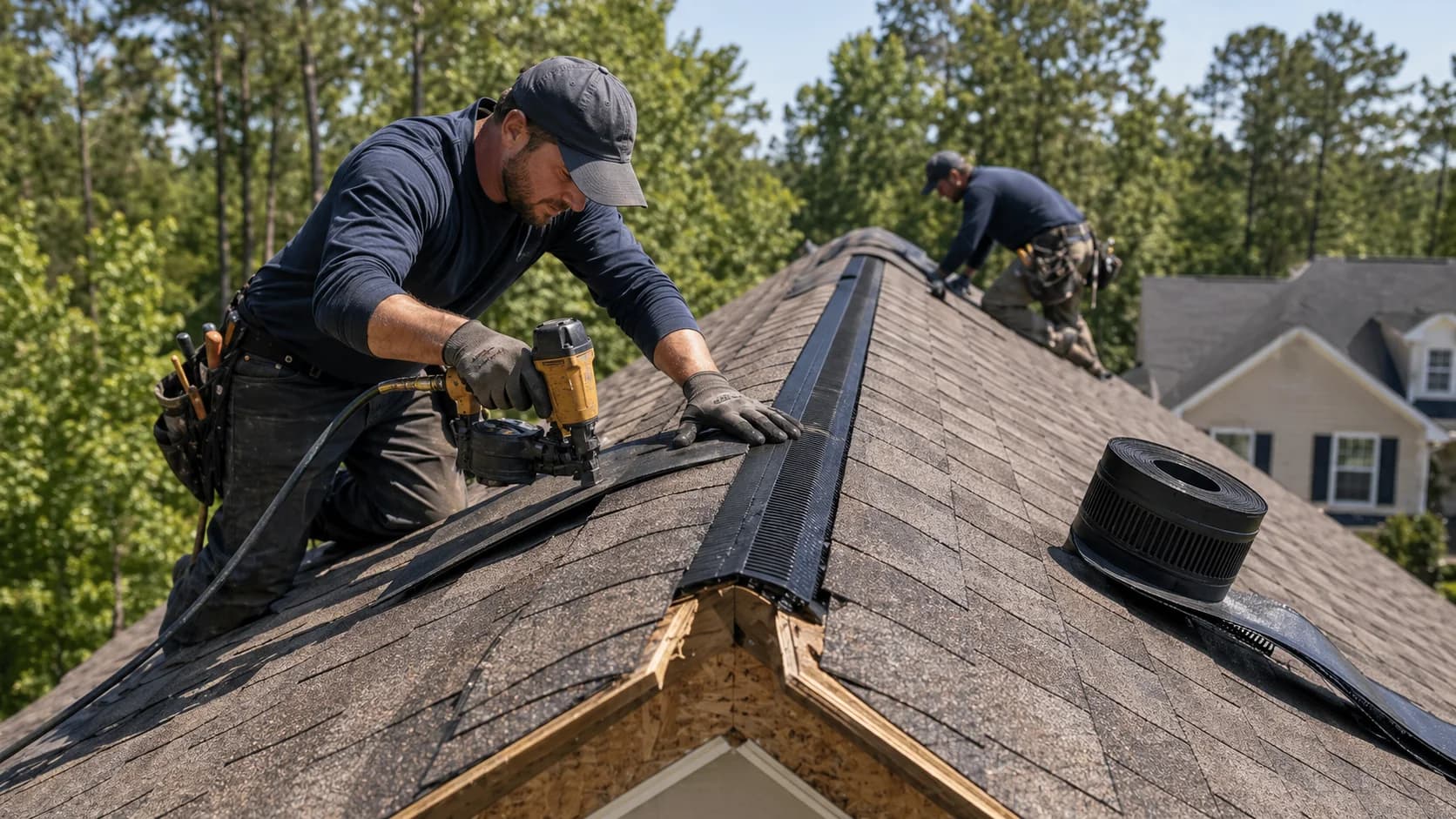
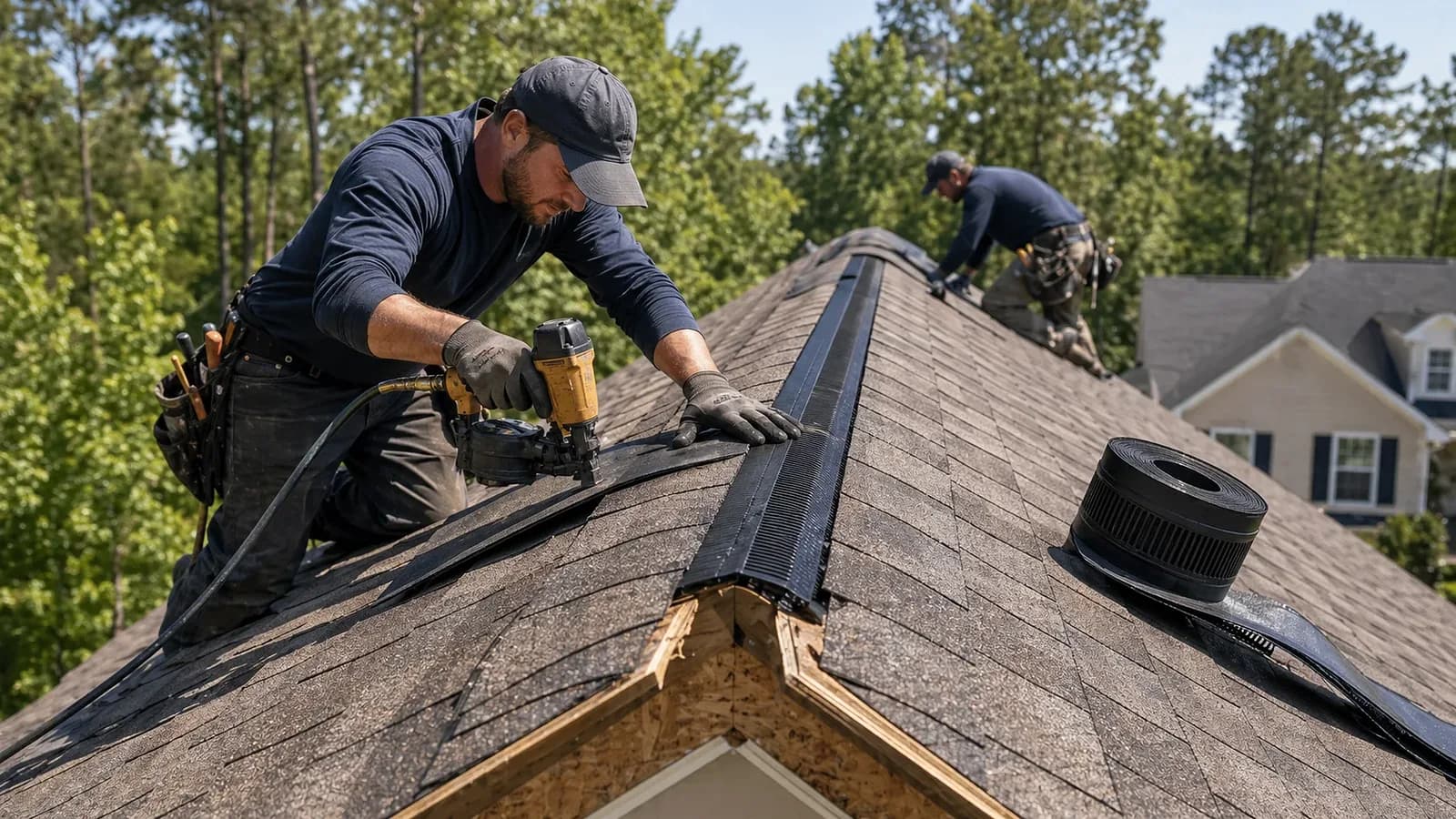
Cut the ridge slot
Saw a 1.5 to 2 inch slot down each side of the ridge with a chalk line for accuracy. Stop the slot 6 inches from each end of the ridge per manufacturer spec.
Install ridge vent
Roll out continuous baffled ridge vent material. Nail to manufacturer spec.
Install matching ridge cap
Color-matched ridge cap shingles laid over the vent material with extended fasteners that penetrate through the vent and into the deck.
What Ridge Vent Installation Costs in Cobb County
Stand-alone ridge vent retrofit runs $800 to $2,500 depending on ridge length and existing roof condition. Bundled with a roof replacement, it adds $300 to $700 to the project total. Adding soffit intake (if missing or inadequate) is a separate cost, typically $400 to $900.
Don't Add Ridge Vent Without Soffit Intake
This is a common Cobb County mistake. Adding ridge vent to a home with no soffit intake creates a vacuum that pulls conditioned air out of the living space and through the attic. Higher energy bills, no improvement in roof life. We always evaluate intake before installing exhaust.
Get a Free Ventilation Assessment
Call (678) 720-3565 or use the contact form. Free attic and roof ventilation assessment with photo documentation and written recommendation.